
Every leader I speak to lately is in the middle of some kind of transformation, and AI is almost always at the heart of it. It makes sense, because AI is here to stay, and nobody wants to be left behind.
My concern is that technology is getting the lion’s share of the investment, both in time and money, when successful transformation asks for investment in AI and in people at the same time. The strongest transformation strategies are designed to integrate the two.
Boston Consulting Group works on the basis that around 70% of the value from AI comes from people and processes. Yet BCG’s own research shows most companies put only around a quarter of their AI budget into developing their people, roughly the reverse of that 70%. One analysis this year suggested AI spending would grow almost nine times faster than training budgets in 2026.
That imbalance shows up most in how leaders and their people talk to each other. After more than twenty-five years helping leaders have the conversations they’d rather avoid, I think AI is about to make those conversations more important than ever…and far easier to skip! As AI handles more of the information, what’s left is the uncertainty and fear that only a real conversation can address, yet it’s now so easy to send an AI-drafted message instead.
From the conversations I’ve been having with leaders, I suspect this is starting to show up in the following ways, each one chipping away at the human connection that change depends on.
Ways that AI-led transformations damage human connection
- Handing the hard conversations to the tool. AI can draft the appraisal or the restructure message perfectly well, but it can’t notice how someone is really taking the news.
- Announcing the change instead of discussing it. Many rollouts arrive through all-staff emails that tell people what’s happening without ever inviting a response.
- Mistaking silence for agreement. Plenty of people don’t feel confident asking for help with AI tools, so they’re even less likely to admit they’re worried about their future.
- Leaving experienced people unsure of their value. When a tool produces in seconds the knowledge someone spent years building, leaders need to help them see where their judgement still matters.
- Punishing the experiments you asked for. Leaders encourage teams to try AI and then react badly when something goes wrong, which teaches everyone to keep their heads down.
Every one of these comes down to how the change is being led, which means every one of them can be designed out.
Why it all comes down to conversation
AI is brilliant at producing answers, but it has no idea what it feels like to be human. The neuroscientist Vivienne Ming makes this case in her new book, Robot-Proof, arguing that AI excels at well-posed problems with a single right answer. People come into their own with ill-posed problems, the messy ones where even the question keeps shifting. That’s exactly the territory a good coaching conversation is built for, and it calls for a transformational mindset in action. A transactional conversation gets the task done and moves on, while a transformational one helps the other person think their way through to their own way forward and take ownership of what happens next. AI can handle plenty of the transactions, so the transformational conversations are where leaders now add the most value.
Transformation asks people to feel safe enough to experiment in front of colleagues and to trust each other, and both depend on human skills (the less taught ones) like curiosity over judgement, generous listening, support balanced with challenge and humanity over pedigree. LinkedIn’s Ryan Roslansky and Aneesh Raman reach the same conclusion in their new book, Open to Work, arguing from data on more than a billion professionals that uniquely human skills are what will help people thrive. The future-of-work expert Dr Paul Redmond went further, naming emotional intelligence as the most AI-proof skill of all. As intelligence becomes abundant, he argues, being “fearlessly human” becomes scarce, and his advice is to compete where AI struggles. I’d add that the real advantage comes when people and AI each do what they’re best at, side by side.
Six small ‘human’ experiments to try this month:
- Run a conversation audit. Ask your team which conversations have shrunk or disappeared since AI tools arrived.
- Agree an “always human” list. Decide with your leadership team which moments, such as performance concerns and redundancy, will always involve a person.
- Track one trust question every quarter. Add “I feel able to say when our use of AI isn’t working” to your pulse survey and watch the score.
- Ask the real question in one-to-ones. Ask how the changes are actually landing for people, then listen without rushing to reassure or fix.
- Review how you’ve announced AI. Count how many of your last five messages about AI invited a reply or a challenge.
- Reinvest the time AI saves. Agree with your team how one hour a week freed up by AI will go back into conversations with each other.
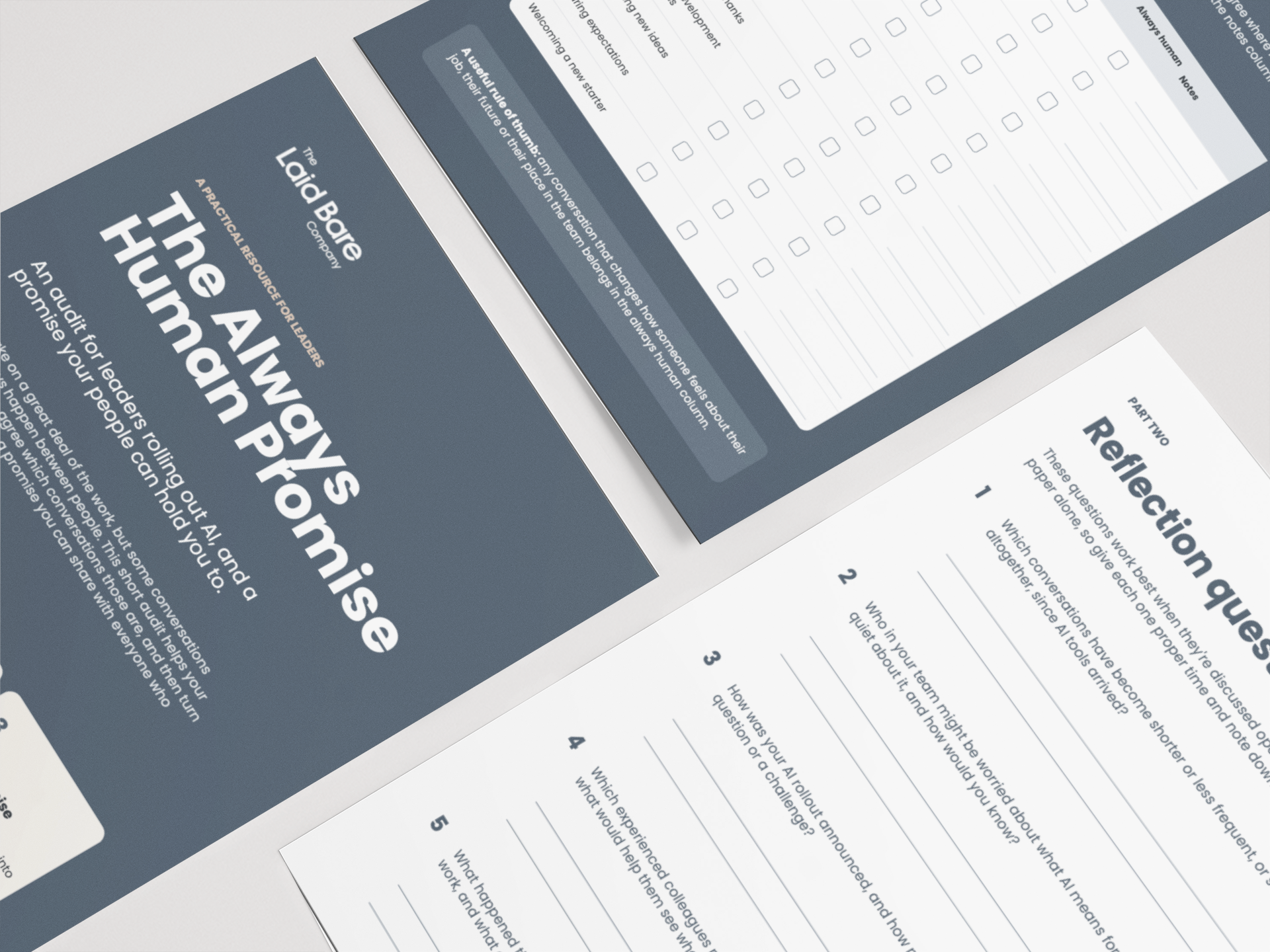
Get a free Always Human Promise Template
A practical audit for leaders rolling out AI.
Integrating humanity and AI
I’m genuinely excited about AI and what it could make possible for all of us. Used well, it could lift a great deal of the ‘doing’ off leaders and give them back time with their people. Imagine a team that trusts each other enough to think out loud, with the technology working alongside them as a partner. That’s the future I want to help build, with transformation strategies designed so that humanity and AI work side by side.
The organisations getting the most from their transformations seem to understand this already. Boston Consulting Group’s latest research found that the CEOs leading the way on AI allocate 60% of their AI budget to developing their people, more than double what most others invest.
So I’m curious: for every pound you are investing in AI, how much are you investing in the humans who’ll make it work? The habits your organisation forms during this transformation will be hard to undo, so the time to get the human side right is now.
In the end, your business transformation will rise or fall on the quality of your next conversation.
